
Uncertainty stemming from the US-Iran conflict has significantly impacted India's mutual fund industry, leading to a sharp decline in new fund offers (NFOs) in March, despite numerous regulatory approvals. This geopolitical tension, coupled with existing market strain and distributor hesitation, has dampened investor sentiment and affected overall inflows.

The information and technology (IT) sector, which has been going through a rough patch lately, was among the top draws for equity mutual funds (MFs) in July. MF schemes together invested a net of Rs 1,800 crores in IT stocks last month after pulling out around Rs 700 crore from the sector in June, according to a report by ICICI Securities.

Some of the public banks showed improvement; much more still needs to be done

276 equity schemes in the market and you don't know which to buy. Here's a list of the proven 10 that should be a part of any mutual fund portfolio
The top five recommended ELSS based on Fundsupermart.com's in-house research methodology.

Had you invested Rs 5,000 every month in SBI Magnum Multicap Fund through systematic investment plan (SIP) for the last 5 years, the value of your investment would be over Rs 5.2 lakh as on August 22, 2016

Investor interest in the mutual fund industry as an avenue to generate long term wealth creation is rising with SIP's asset base touching an all-time high of Rs 4.67 lakh crore at May-end. Over the past five years, the systematic investment plan or SIP AUM has grown 30 per cent annually, twice as fast as the growth in the overall mutual fund industry's assets under management (AUM). According to data released by Association of Mutual Funds in India (Amfi) on Wednesday, SIP AUMs have seen a close to four-fold jump to Rs 4,67,366 crore as of May this year from Rs 1,25,394 crore as of August 2016.

A simple SIP-first approach can help reduce debt, avoid EMIs and build lasting financial freedom through disciplined spending, advises Ramalingam Kalirajan
American Express Bank is open to acquiring Indian banks and mutual funds as part of the efforts to increase its presence in the country.

The Securities and Exchange Board of India (Sebi) could soon issue interim orders imposing a market ban on the two former fund managers of Axis Mutual Fund (MF) for suspected front-running of trades, said people with knowledge of the development. "The market regulator has gathered prima facie evidence that demonstrates that the duo has violated the integrity of the market. "While a detailed investigation is still pending in the matter, Sebi could take action under Section 11 (4) to prevent further harm to the investors and the securities market," said a source.

In modern investing, transparency is more valuable than zero fees and not all investing app score big on this front, says Ramalingam Kalirajan.
There's something about a top-performing fund. The glowing reviews, self-congratulatory advertisements by the fund house and a host of stars (read ratings) and awards. It's a pretty heady mix. Sadly, the NAV performance in isolation presents a one-dimensional picture i.e. it may conceal more than it reveals. In this article, we make a case for looking beyond just the NAV performance by listing instances, when top-performing funds could potentially be bad investments.

'Mark Mobius's life was dedicated to investing.'

'Investing in these funds makes sense if their net yield over better-quality funds -- corporate bond funds or banking and PSU funds -- is meaningful.'

If your fund unjustifiably holds a large amount of cash, stop investing and take a relook at its capability to spot opportunities.
Though the fund houses have garnered over Rs 1,500 billion from investors, only 8-10 would declare their monthly FMP portfolios till a few months ago. Instead, they gave 'indicative portfolios' and 'indicative returns' to the potential investor. This month, all fund houses declared the portfolios of their schemes because of the half-yearly results. And, to the horror of many investors, the real portfolios were 80-90 per cent different from the 'indicative portfolios.'

The Congress party has accused Home Minister Amit Shah of launching an "onslaught" on the Opposition and "wrecking" Indian democracy. The party alleges that Shah is enticing elected representatives to join the BJP with significant incentives, a claim echoed by Shiv Sena (UBT) leader Sanjay Raut regarding Maharashtra MPs. This comes amidst reports of defections from other parties like the TMC.

The cash pile within smallcap mutual fund (MF) schemes has grown over the past few months amid a relentless rally in stocks in this space. While fund managers usually don't make cash calls, incessant inflows and valuation discomfort have forced their hand. At the end of January, the top 10 schemes had over Rs 12,160 crore in cash, compared to Rs 8,700 crore in August 2023.
While mutual funds charge fees of 1-1.5 per cent of assets managed, that for pension funds could be a hundredth since the two investment streams are dramatically different.
Five things you must know before investing in mutual funds and you will be less likely to fret during market ups and downs.

Anil Rego, CEO, Right Horizons, answers your personal income tax queries.
Fund companies deny the existence of 'star managers' to understate key man-risk; investors on their part, must evaluate if the fund remains as good a bet, sans its 'star'.
Two ratios can help you in monitoring your mutual funds' performances and finding worthy ones.
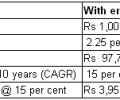
Mutual fund investors will be able to earn more on their investments because of the Securities and Exchange Board of India ruling on the removal of 2.25 per cent entry loads on their investments.
If you don't have enough time to study the market, go for mutual funds, says personal finance expert Rahul Goel.

In April alone, they snapped up shares worth Rs 19,664 crore, recording their biggest buy since October 2024.

The time is ripe for a merger of eight fund houses indirectly owned and controlled by the central government, says N Sundaresha Subramanian.

Mutual fund houses do have several challenges ahead to win more investors.
These funds have scored the best on the Morningstar Risk and Return rating grades.

IT stocks had their worst first half fall in decades, with the Nifty IT index declining 31% in the January-June 2026 period, its biggest decline in the first six months of a calendar year since 2003.

"Taxpayers with income from shares, mutual funds, crypto, ESOPs, or derivatives often incorrectly use ITR-1 instead of ITR-2 or ITR-3."
But you may need to do some running around to obtain a no-objection certificate from your earlier agent if you have switched agents
Ten Indian states contribute a lion's share of 95% or Rs 12.25 lakh crore.

The Sebi chief said that although the idea of an SRO has been challenged in court, he is hopeful of its implementation.

Investors should do thorough due diligence when selecting a platform.
